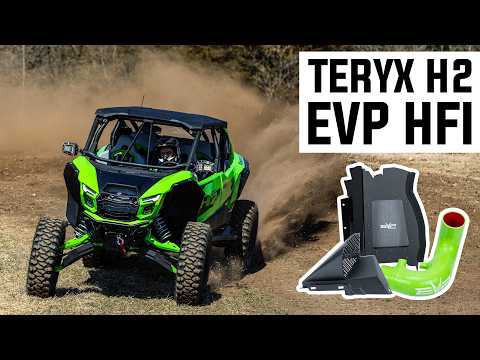
The EVP H2 HFI intake system for the Kawasaki Teryx H2 is engineered to improve supercharger efficiency through optimized airflow management and pressure recovery. Drawing on over 20 years of intake design experience, this system is built around three core principles:
-
Maximize Airflow Efficiency by increasing filter surface area to reduce restriction while maintaining effective filtration.
-
Utilize High-Pressure Airflow by positioning the inlet of the EVP HFI in a true high-pressure zone, avoiding low-pressure areas (such as behind fender walls or firewalls) that reduce compressor inlet pressure and overall efficiency.
-
Deliver Clean, Controlled Airflow by reducing turbulence and improving flow uniformity as air enters the supercharger.
Engineered Airflow
The OEM compressor inlet allows turbulent, non-uniform airflow into the compressor. The EVP system addresses this with an included billet, port-matched velocity stack designed to smooth airflow transition into the compressor, reduce turbulence, and increase air velocity prior to compressor entry. The result is improved compressor efficiency, increased mass airflow, and measurable performance gains.
Purpose-Built Performance
This system is designed with a clear focus: maximum performance and aggressive styling. Expect increased intake sound compared to OEM as this system is strictly designed for riders who prioritize performance over quiet operation.
Ideal Riding Conditions
The EVP HFI is engineered for real-world off-road environments and is safe for water/mud levels that creep just above the belly pan. This HFI is not intended for deep water crossings or mud bogging.
- Sand
- Trail riding
- Desert and desert racing (BITD, SCORE)
- Light mud
- Rock crawling
- Shallow river crossings
Proven Filtration
The H2 HFI uses the same custom, high-performance filter as our Maverick R HFI system, which is manufactured in the U.S.A. by a top-tier filtration partner exclusively for EVP. This filter has been proven in all disciplines of racing by the top race teams (including ours) in the U.S.
Silicone vs. Carbon Fiber: Why We Don’t Use Carbon Fiber Intake Tubes
There’s a growing trend among certain off-road brands to use carbon fiber intake tubes. While visually appealing, carbon fiber introduces real risks in off-road environments.
Impact Risk
- One rock strike in the wrong place can crack carbon fiber
- Debris ingestion can damage the supercharger or engine in seconds
- Silicone absorbs impact and resists failure—even under extreme abuse
More Connections = More Failure Points
- Carbon systems require multiple joints and clamps
- Each connection introduces potential leaks or separation points
- EVP silicone design minimizes connections for maximum reliability
Rigidity is a Liability
- Carbon fiber does not flex with chassis movement or vibration
- In harsh terrain (whoops, rocks, high-speed desert), this increases the chance of failure
- Silicone flexes with the vehicle, maintaining a secure, sealed system
These are not theoretical concerns—they’re lessons learned through real-world racing and development with top teams in the industry.
Built to Perform. Designed to Stand Out.
We set out to build the most aggressive, functional intake system available—and the result speaks for itself. From the sight glass, to the powder-coated metal structure, to the above-fender high-pressure intake duct, every detail is engineered for both performance and visual impact. This isn’t just an intake—it’s a statement.
KIT INCLUDES:
- Choice of Black or Green EVP 6-layer, wire-reinforced silicone
- Choice of Black or Carbon Fiber ram-air scoop
- EVP High-Flow Air Filter & enclosure assembly
- Billet, port-matched velocity stack
- All hardware and clamps required for installation
 BUY NOW, PAY LATER. Starting at 0% APR